Family and everyday life
Screens and ADHD in children
Screens are part of children's and teenagers' family, school, and social lives. They can be used to learn, play, create, communicate, or relax, but can also make some transitions or evening periods harder.
When a child has attention difficulties, it can be tempting to see screens as the cause of everything or, conversely, as the only activity that calms them. Both interpretations are too simple: observed associations are complex and depend on content, context, age, routines, and the child's experience.
This guide offers guidance without blame for observing usage, discussing realistic rules, and knowing when to seek advice.
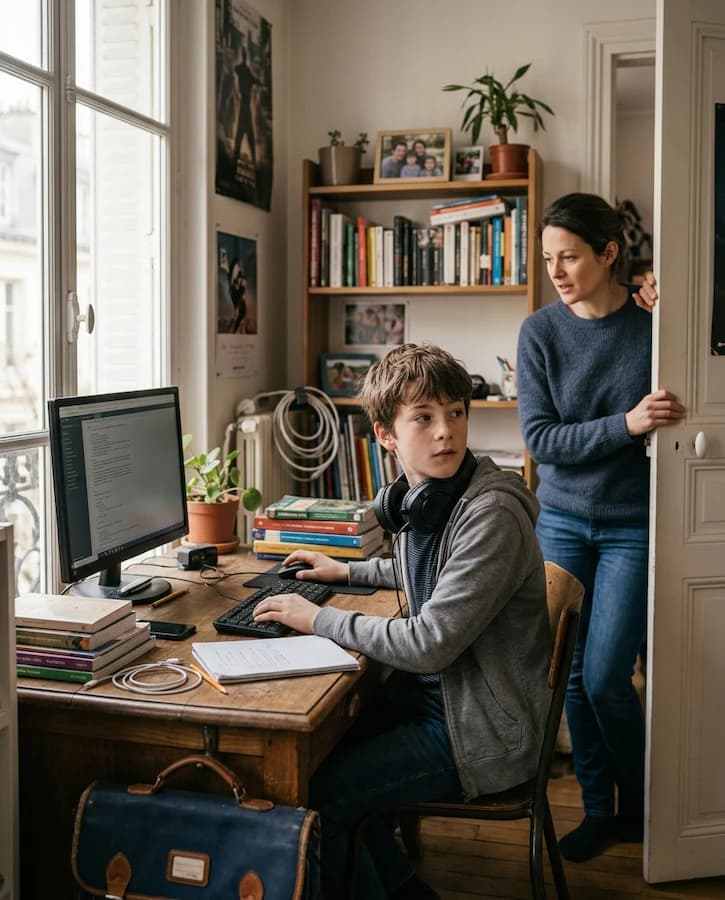
Screens and daily life
Digital media use is better understood through content, timing, and family context than through a single rule.
Avoid jumping to explanations
A child may stay engaged in a digital activity for a long time yet struggle to start a less appealing task. This contrast alone does not explain attention difficulties: it may reflect how the activity works, motivation, fatigue, current readiness, or other factors.
Studies of digital media use and attention symptoms call for caution. They describe possible links but do not establish that a screen causes ADHD or that ADHD alone explains usage that is difficult to regulate.
Look at how screens are used, not only screen time
Making these distinctions allows discussion of a concrete situation instead of reducing the topic to a daily total or a judgment about the child.
Content and purpose
Gaming, videos, messaging, creating, school research, and calls with loved ones have different purposes and effects throughout the day.
Timing and transition
After school, during a meal, before homework, or in the evening, usage involves different needs and constraints.
Family context
Age, fatigue, sleep, available alternative activities, and shared rules shape how children experience screens.
Screen time, content, and problematic use are three different questions
Counting minutes is not enough to understand a situation. Also consider what the child does, when, with whom, what the screen replaces, and what happens when they have to stop. A shared creative activity serves different purposes from late-night scrolling or a game that takes over every transition.
The systematic review by Thorell and colleagues describes longitudinal associations in both directions between ADHD symptoms and digital media use, with more consistent associations for problematic use than screen time alone. These findings do not establish that screens alone cause ADHD; sleep, relationships, and preexisting vulnerabilities may contribute to these trajectories.
Why stopping can become the hardest moment
Digital activities offer rapid feedback, clear goals, and little downtime. Moving to a less stimulating task requires interrupting an action, tolerating frustration, and redirecting attention. Giving advance notice, making the rule visible, and planning the next activity can reduce conflict without guaranteeing an emotion-free transition.
A rule works better when it is predictable, age-appropriate, and consistently upheld by adults. It should also reflect the child's actual social and school life rather than presenting every use as a failure.
Signs that usage deserves closer attention
These observations call for discussion of the whole situation and sometimes professional advice; they are neither an ADHD test nor an addiction diagnosis.
- Sleep, physical activity, meals, or school are regularly displaced;
- The child persistently loses interest in other activities;
- Conflicts are intense and repeated despite understandable rules;
- Usage almost always serves to escape worry, loneliness, or distress;
- The child is exposed to bullying, inappropriate content, or online risks.
Guidance for parents: gradual rules discussed together
The most useful rules are generally understandable, realistic, and applied with some consistency. They benefit from evolving with age and taking each family's uses into account.
- Give advance notice that an activity is ending and plan the transition to what comes next
- Distinguish school, creative, social, and recreational uses in family discussions
- Protect shared screen-free moments, particularly around meals or bedtime as needed
- Discuss content and notifications with the child rather than deciding solely on a number
- Reassess rules when they create more conflict than guidance
Sleep, family routines, and situations worth discussing
Evening screens, notifications, and difficulty disconnecting can interfere with falling asleep or sleep quality. Sleep then deserves attention in its own right, without assuming it explains every daytime difficulty.
When usage becomes an ongoing source of distress, conflict, isolation, or school difficulties, it may help to discuss it with the child and then a professional. The aim is to understand the whole situation, not to assign blame.
Cereya ADHD
Review everyday habits without oversimplifying
Cereya's child ADHD assessment offers an informational space for parents and children to put everyday situations into words.
It does not measure digital media use, investigate its causes, or establish an ADHD diagnosis.
- assessment supported by a parent or legal guardian
- questions for the parent and child
- brief attention exercises adapted to age
- informative report with points requiring caution
- no medical diagnosis
Initial summary included; detailed analysis available afterward.
Screens and daily life
Digital media use is better understood through content, timing, and family context than through a single rule.
FAQ
Frequently asked questions
Do screens cause ADHD?+
No. Screens alone cannot explain or diagnose ADHD. Research describes complex and sometimes reciprocal associations between certain digital activities and attention difficulties; it does not support a single explanation.
Why is stopping sometimes difficult?+
Some digital activities are designed to capture attention and make stopping difficult. Content, timing, duration, age, fatigue, and family rules matter as much as the number of minutes displayed.
Should school screen use and leisure be counted in the same way?+
Distinguishing schoolwork, contact with loved ones, leisure, and evening use helps clarify the situation. The aim is not to treat all screens alike, but to look at their effects on the child's daily life.
How can you set realistic rules?+
Simple, predictable rules that are discussed together are often more sustainable than changing bans. They may cover screen-free times, transitions, sleep, and content, then be adjusted with age and family needs.
When should you seek advice?+
Advice may be useful when usage has an ongoing impact on the child's sleep, relationships, schooling, or well-being, or becomes a major source of conflict. A professional can help place these difficulties in the wider situation.
References and resources
This guide draws on recommendations for children and adolescents. They are presented for educational purposes without reproducing diagnostic criteria.
- Haute Autorité de Santé (2024) — Neurodevelopmental disorder/ADHD: diagnosis and therapeutic interventions for children and adolescents
- Haute Autorité de Santé (2015) — Primary care management of a child or adolescent with suspected ADHD
- NICE guideline NG87 — Attention deficit hyperactivity disorder: diagnosis and management
- American Academy of Pediatrics (2019) — Clinical Practice Guideline for the Diagnosis, Evaluation, and Treatment of ADHD in Children and Adolescents
- Faraone et al. (2021) — The World Federation of ADHD International Consensus Statement: 208 Evidence-based conclusions about the disorder
- American Psychiatric Association — DSM-5-TR, referenced descriptively without reproducing diagnostic criteria.
- World Health Organization — ICD-11, referenced descriptively as an international classification framework.
- Assurance Maladie — ADHD: symptoms, diagnosis, and development in children.
- Assurance Maladie — ADHD: prescribed care and support for children.
- Assurance Maladie — My child sleeps poorly: guidance and advice for parents.
- Assurance Maladie — ADHD: medical follow-up, daily life, and schooling for children.
- Assurance Maladie — How can screen use be adapted to a child's or teenager's age?
- Thorell et al. — Longitudinal associations between digital media use and ADHD symptoms in children and adolescents: a systematic literature review (2024).
Explore further