Family and everyday life
How to support a child with ADHD in everyday life
Routines, homework, transitions, sleep, or emotions can demand considerable energy from a family. When attention, impulsivity, or restlessness complicate certain moments, parents often look for very practical support.
There is no method that works for every child. Strategies benefit from being simple, gradual, and adapted to age, the child's preferences, and what actually happens in the family.
This guide offers insights to make daily life easier to navigate, support independence, and observe what helps without turning the home into a place of constant assessment.
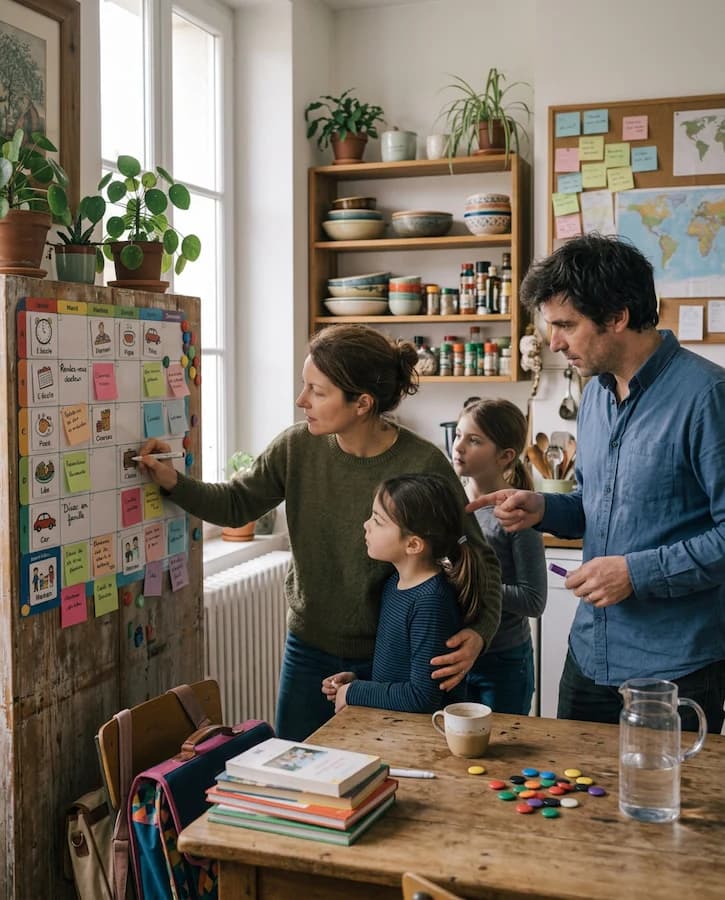
Support in everyday life
A more predictable daily life can support the child without erasing their personality or needs.
Look for support before trying to fix everything
A recurring difficulty does not mean the child lacks goodwill or the parent is doing things wrong. The most demanding moments may simply require more structure, time, or support.
Observing what precedes a difficulty, what happens during it, and what helps afterward allows better-targeted adjustments than adding a rule in a rush.
Routines that support without becoming rigid
The same tools are not useful every day. Trying them mainly helps identify what makes a situation easier and what tires the child more.
Make the steps predictable
A short sequence for mornings, homework, or bedtime can make the next step visible. It can evolve with the child rather than becoming a fixed constraint.
Prepare transitions
Announcing a change, allowing transition time, or offering a choice between two realistic options can reduce rushing and conflict.
Adjust the environment
A quiet place, materials kept together, or fewer distractions can help the child start a task without the environment doing everything for them.
Lighten the invisible workload of routines
Getting ready, tidying up, or leaving home seems simple to an adult because the sequence is automatic. For a child, it can require holding several steps in mind, resisting distractions, estimating time, and stopping an enjoyable activity. A useful routine makes these steps visible and predictable instead of multiplying reminders from a distance.
Start with one particularly demanding moment, describe the actual steps, then remove anything unnecessary. A short list, belongings prepared in the same place, or a transition signal can support independence. If an adult still needs to guide, this does not mean the tool has failed: support can be reduced gradually.
Give an instruction the child can actually use
These insights do not guarantee conflict-free daily life. They mainly reduce misunderstandings between “the child knows what to do” and “the child can act on that instruction now.” They should remain compatible with age, abilities, and the whole family's needs.
- move closer and get their attention before speaking;
- name a concrete action rather than a vague prohibition;
- give few steps at a time and check understanding;
- allow a realistic interval before repeating;
- notice the completed step, not just what remains.
Organize without doing things for the child
Supporting independence means offering just enough help for the child to take ownership of the next step. The aim is not immediate independence, but achievable progress.
- break a broad request into a clear first step
- give the child time to start before adding a reminder
- use a simple aid for frequently recurring tasks
- review what helped, not just what was not done
- gradually increase what the child can manage alone
Consider routines, emotions, and encouragement
Sleep difficulties or emotional reactions can have many causes. They can be addressed in their own right with a professional if they persistently affect the child or family.
Sleep and recovery
Fatigue, irregular schedules, or waking during the night can affect attention and emotional availability. They deserve careful description without assuming a single cause.
Emotions and calming down
After a demanding day, time to decompress, an announced transition, or a quiet activity can help some children feel settled again.
Specific encouragement
Specific encouragement about effort, a strategy used, or making things right after conflict values learning rather than judging the child.
Cereya ADHD
Take stock of what supports your child in everyday life
This assessment combines the parent's observations, the child's perspective, and brief age-appropriate exercises.
It supports reflection on everyday life without replacing professional support when that is helpful.
- assessment supported by a parent or legal guardian
- questions for the parent and child
- brief attention exercises adapted to age
- informative report with points requiring caution
- no medical diagnosis
Initial summary included; detailed analysis available afterward.
Support in everyday life
A more predictable daily life can support the child without erasing their personality or needs.
FAQ
Frequently asked questions
Must a routine be followed to the letter?+
No. A routine can provide structure, but should remain flexible. The aim is to make some steps more predictable, not to control every moment or avoid all frustration.
How can I support independence without doing everything for my child?+
Independence often develops in small steps. A visual aid, limited choices, or a task broken down into steps can help the child do more independently without leaving them alone with an overly broad instruction.
Does sleep explain attention difficulties?+
Sleep can influence attention, mood, and recovery. Sleep difficulties do not explain ADHD on their own, and ADHD is not enough to explain sleep: the context deserves discussion if the difficulty persists.
How can I encourage without minimizing difficulties?+
Specific encouragement focused on effort, a strategy, or a completed step may help more than a general reminder. The aim is not to praise everything constantly, but to make progress and effective support visible.
Can a questionnaire provide a personalized support plan?+
No. A questionnaire cannot choose a routine, explain an emotion, or determine a family's needs. It can help organize examples and prepare a professional discussion.
References and resources
This guide draws on recommendations for children and adolescents. They are presented for educational purposes without reproducing diagnostic criteria.
- Haute Autorité de Santé (2024) — Neurodevelopmental disorder/ADHD: diagnosis and therapeutic interventions for children and adolescents
- Haute Autorité de Santé (2015) — Primary care management of a child or adolescent with suspected ADHD
- NICE guideline NG87 — Attention deficit hyperactivity disorder: diagnosis and management
- American Academy of Pediatrics (2019) — Clinical Practice Guideline for the Diagnosis, Evaluation, and Treatment of ADHD in Children and Adolescents
- Faraone et al. (2021) — The World Federation of ADHD International Consensus Statement: 208 Evidence-based conclusions about the disorder
- American Psychiatric Association — DSM-5-TR, referenced descriptively without reproducing diagnostic criteria.
- World Health Organization — ICD-11, referenced descriptively as an international classification framework.
- Assurance Maladie — ADHD: symptoms, diagnosis, and development in children.
- Assurance Maladie — ADHD: prescribed care and support for children.
Explore further