School and learning
ADHD at school
At school, following an instruction, waiting your turn, organizing materials, concentrating amid noise, or finishing an activity requires many resources. Some difficulties may then become more visible to the child, family, or teachers.
These observations are not enough on their own to establish ADHD. It helps to compare them with what happens at home, during leisure activities, and in relationships, considering age, learning, and the school context.
This guide helps prepare a concrete dialogue between family and school, understand the potential role of adjustments, and recognize when to seek professional advice.
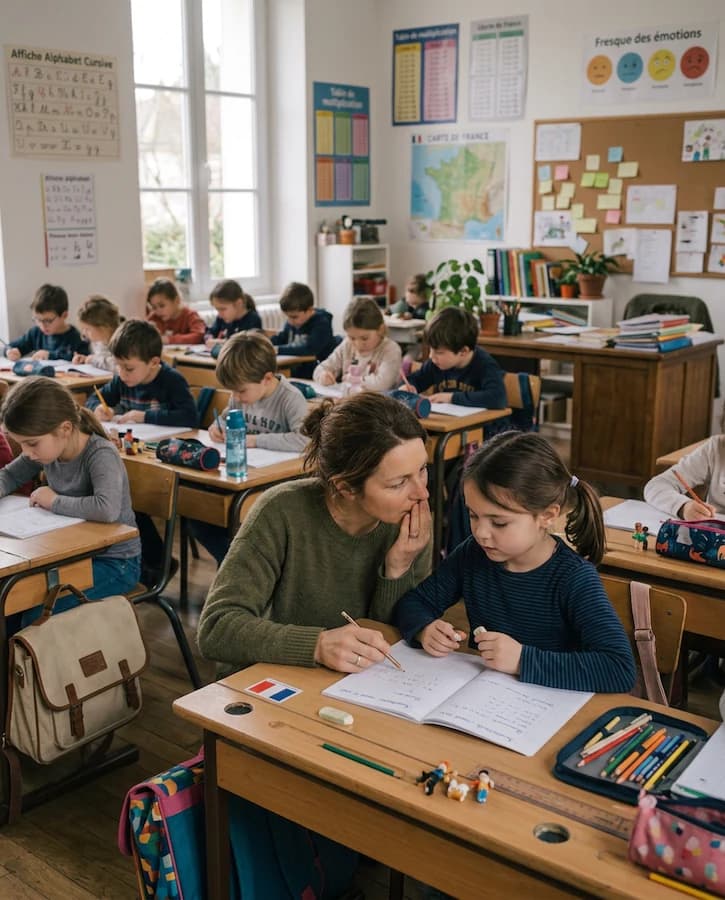
ADHD and school
School provides important examples that need to be considered within the child's development and daily life.
At school, observe situations rather than a label
School does not reveal a different truth from home: it creates different demands. Listening to an explanation, copying, starting a task, managing several steps, waiting, or adapting to a group can take considerable effort for some children.
What matters is describing how frequently difficulties occur, when they appear, their impact, and support that seems useful. A difficult day or an isolated comment is not enough to draw a conclusion.
What can school observe?
These examples may also be influenced by comprehension, sleep, anxiety, learning, peer relationships, or a transition in the school year.
Attention and instructions
Losing a step, forgetting an instruction, or struggling to get started may be more visible when work involves several pieces of information to remember.
Movement and transitions
Noise, waiting, transitions, or an activity that requires sitting still can increase fatigue or restlessness in some children.
Learning and organization
Notebooks, homework, materials, copying time, and planning provide useful examples for understanding the child's organizational needs.
Group life and relationships
Waiting your turn, tolerating frustration, or understanding a group rule may require particular support depending on the situation.
School calls on several functions at once
Following a lesson requires more than “paying attention.” The student must listen, select useful information, keep an instruction in memory, organize materials, start, check, and adjust to the group. A difficulty may therefore show up in unfinished work, forgetfulness, transitions, speaking turns, or exhaustion even when the child understands the concept being taught.
The school impact is not limited to grades. Excessive time spent on work, repeated conflict, loss of confidence, disciplinary measures, or isolation are also important to describe. Conversely, good results do not rule out a high cost for the child.
Start from a specific obstacle when choosing an adjustment
Understand the task
If instructions get lost, making them visible, rephrasing them, or breaking them down may be more useful than a general reminder to listen.
Get started
If getting started is difficult, an explicit first step and brief feedback may help without doing the work for the student.
Adjust the context
If the environment is overwhelming, classroom seating, the amount of visible information, or a planned break can be discussed.
Useful collaboration produces comparable observations
School-family discussions benefit from focusing on one or two observable situations: starting work, handing in homework, transitions, or playground conflicts. You can define what will be tried, for how long, and which indicator will show improvement. This avoids general judgments such as “they make no effort.”
Accommodations replace neither teaching nor clinical assessment. They address a functional need and should be reassessed. The dedicated school accommodations guide details possible arrangements without turning this general page into a duplicate administrative resource.
How can you support family-school cooperation?
Family-school cooperation aims to make daily life easier for the child to navigate. It does not assume parents or teachers must find a single explanation on their own.
- share a few specific examples rather than a general impression
- identify when the child does better and supports already helping
- agree on a realistic communication channel that respects everyone
- involve the child in discussions in an age-appropriate way
- reassess adjustments when needs or circumstances change
What adjustments can be discussed?
Adjustments should be discussed with adults who know the child. They can support many students and are not proof of ADHD.
Make the task clearer
A short instruction, rephrased or accompanied by a visual aid, can reduce what the child must hold in mind at once.
Provide structure without overload
Breaking down an activity, announcing a transition, or checking the starting point can help reduce overload and repeated reminders.
Offer encouraging feedback
Concrete feedback about effort, strategies that helped, or an observed success avoids reducing the child to their difficulties.
Cereya ADHD
Prepare useful observations to discuss school
Cereya's child ADHD assessment offers an initial supported exploration based on a parent's perspective, the child's experience, and brief age-appropriate exercises.
It can help organize observations about daily life and school without confirming or ruling out ADHD.
- assessment supported by a parent or legal guardian
- questions for the parent and child
- brief attention exercises adapted to age
- informative report with points requiring caution
- no medical diagnosis
Initial summary included; detailed analysis available afterward.
ADHD and school
School provides important examples that need to be considered within the child's development and daily life.
FAQ
Frequently asked questions
Can a school diagnose ADHD?+
No. School provides valuable observations about instructions, organization, learning, and group life, but does not make a diagnosis. Its feedback complements that of the family and child.
Why do difficulties seem to vary between subjects?+
Not always. The same difficulty may be more visible in a long, noisy, or unstructured task and less visible when a child is very interested or supported. These differences are useful to describe.
What adjustments can be considered at school?+
Adjustments can be discussed according to need: rephrased instructions, tasks broken down into steps, visual cues, transition time, or positive feedback. They are neither automatic nor identical for every child.
How can I cooperate with the teacher without blaming my child?+
A concrete conversation is often easier: describe difficult moments, what helps, successes, and observed changes. The aim is to understand the child's needs better, not to find someone to blame.
Can an online questionnaire explain school difficulties?+
No. A questionnaire can help structure examples and compare settings. It does not replace a clinical interview, examination of the child, or information gathered from those around them.
References and resources
This guide draws on recommendations for children and adolescents. They are presented for educational purposes without reproducing diagnostic criteria.
- Haute Autorité de Santé (2024) — Neurodevelopmental disorder/ADHD: diagnosis and therapeutic interventions for children and adolescents
- Haute Autorité de Santé (2015) — Primary care management of a child or adolescent with suspected ADHD
- NICE guideline NG87 — Attention deficit hyperactivity disorder: diagnosis and management
- American Academy of Pediatrics (2019) — Clinical Practice Guideline for the Diagnosis, Evaluation, and Treatment of ADHD in Children and Adolescents
- Faraone et al. (2021) — The World Federation of ADHD International Consensus Statement: 208 Evidence-based conclusions about the disorder
- American Psychiatric Association — DSM-5-TR, referenced descriptively without reproducing diagnostic criteria.
- World Health Organization — ICD-11, referenced descriptively as an international classification framework.
- Assurance Maladie — ADHD: symptoms, diagnosis, and development in children.
- Assurance Maladie — ADHD: prescribed care and support for children.
- Veenman, B., Luman, M., Hoeksma, J., Pieterse, K. & Oosterlaan, J. (2018). Efficacy of behavioral classroom programs in primary school. A meta-analysis focusing on randomized controlled trials. PLOS ONE, 13(10), e0201779. DOI: 10.1371/journal.pone.0201779. PMID: 30303966.
Explore further