Adolescence and daily life
ADHD in teenagers: signs, independence, and support
Adolescence is neither simply an extension of childhood nor adult ADHD in miniature. Expectations change: more complex schedules, independent work, travel, relationships, sleep, and the pursuit of independence take on new importance.
For some teenagers, hyperactivity becomes less visible from the outside, while the effort needed to organize, start, finish, or manage several demands can remain considerable. Other difficulties can also emerge or become more noticeable during this period.
This guide offers pointers for supporting teenagers respectfully, considering their perspective, and knowing when a professional conversation may be useful, without making a diagnosis.
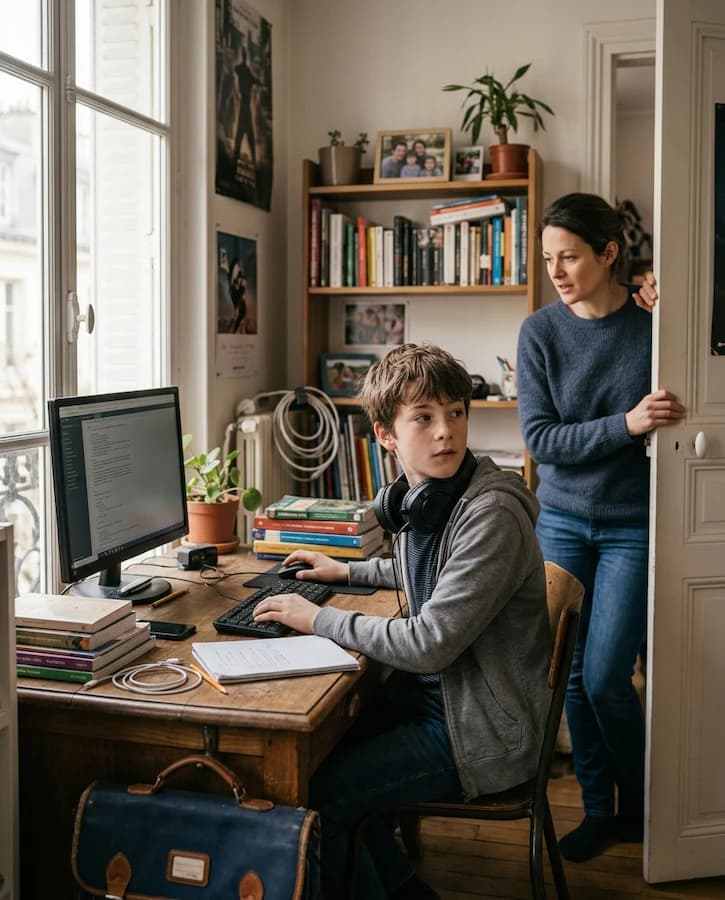
ADHD and adolescence
Adolescence brings new reference points, new demands, and a growing place for the young person's voice.
Features that can change with age
With age, environments become more complex and adults expect more independent organization. Remembering several deadlines, prioritizing, planning travel, or distributing work can take substantial effort, even when teenagers understand what is expected.
Restlessness can also take less visible forms: feeling rushed, difficulty staying with an activity, or a need to move or seek stimulation. These observations must always be considered alongside development, context, and their actual impact on the young person.
Why daily life may call for new supports
These difficulties are not specific to ADHD. They can, however, help describe situations in which teenagers need support or, conversely, feel capable.
More fragmented school demands
Moving between subjects, rooms, teachers, and platforms can increase the information to remember and the steps to organize.
Developing independence
Tidying, planning, starting homework, and asking for help are developing skills. They do not all progress at the same pace.
A more independent social life
Friendships, conflicts, others' opinions, and self-esteem can become particularly important. The teenager's own experience deserves to be heard directly.
During adolescence, demands change faster than visible symptoms
Schedules become more fragmented, homework is less supervised, relationships take up more space, and decisions have greater consequences. Physical restlessness may become less apparent while lateness, forgetfulness, risk-taking, shifted sleep schedules, or planning difficulties become central. These need to be considered within normal development toward independence, without medicalizing everything.
Teenagers may also have developed effective but costly strategies: working very late, relying on a parent for every deadline, or avoiding activities in which they fear failure. Adequate results do not always reveal the level of effort or distress.
Move from parental control toward supported independence
Independence does not mean immediately withdrawing all help. You can agree together on what is the teenager's responsibility, what will still be checked, and how to ask for help. A shared calendar, weekly check-in, or reminder chosen together is generally more respectful than constantly monitoring every task.
Goals need to matter to the young person: arriving on time for an important activity, protecting sleep, completing a process, or reducing a recurring conflict. Participation in care and support decisions is recommended and becomes increasingly important with age.
Guidance for parents: support without treating teenagers like small children
Supporting independence means neither withdrawing all help nor monitoring every detail. The challenge is to find concrete supports together that the young person can gradually make their own.
- Choose a realistic priority with the teenager instead of multiplying reminders
- Discuss tools they are actually willing to use: a planner, short list, reminder, or preparation time
- Agree on brief check-ins rather than constant monitoring
- Recognize efforts, strategies, and successes, including those that are less visible
- Make room for their preferences and objections in decisions that affect them
Sleep, routines, relationships, and self-esteem: the broader picture
Sleep, daily rhythms, and recovery deserve attention in their own right. During adolescence, schedules, screens, notifications, or school pressure can change evenings and days, with possible effects on attention and emotions.
Discussions with middle or high school can also help compare settings and consider useful adjustments. Depending on the situation, a professional can help understand associated difficulties, other possible explanations, and appropriate support.
Cereya ADHD
Put your teenager's needs into words
Cereya's child ADHD assessment combines parent observations, the teenager's perspective, and short attention exercises adapted to age.
It remains informational: it does not provide a diagnosis or replace a professional conversation when difficulties affect daily life.
- assessment supported by a parent or legal guardian
- questions for the parent and child
- brief attention exercises adapted to age
- informative report with points requiring caution
- no medical diagnosis
Initial summary included; detailed analysis available afterward.
ADHD and adolescence
Adolescence brings new reference points, new demands, and a growing place for the young person's voice.
FAQ
Frequently asked questions
Does ADHD look the same in adolescence?+
Some features can change with age. Physical restlessness may become less visible, while organization, time management, school demands, or emotions sometimes become more prominent. These changes alone do not establish anything: they need to be understood within the teenager's history and settings.
How can you support independence without controlling everything?+
Independence develops gradually. Clarifying a priority, preparing a transition, or discussing what works can support teenagers without making decisions for them. Needs vary with age, school demands, and family circumstances.
Why can school become more demanding?+
Middle and high school can involve more classes, teachers, deadlines, and moving between locations. Specific examples involving assigned work, organization, or fatigue can help open a conversation with the school when useful.
What role can sleep play?+
Sleep changes during adolescence and can be affected by daily routines, screens, schedules, or worries. It can affect daytime readiness without explaining every difficulty or being explained by ADHD alone.
When should you seek professional advice?+
Advice may be useful when difficulties persist, affect school, family, social, or emotional life, or when the teenager expresses distress. You do not need to be certain about ADHD to seek advice.
References and resources
This guide draws on recommendations for children and adolescents. They are presented for educational purposes without reproducing diagnostic criteria.
- Haute Autorité de Santé (2024) — Neurodevelopmental disorder/ADHD: diagnosis and therapeutic interventions for children and adolescents
- Haute Autorité de Santé (2015) — Primary care management of a child or adolescent with suspected ADHD
- NICE guideline NG87 — Attention deficit hyperactivity disorder: diagnosis and management
- American Academy of Pediatrics (2019) — Clinical Practice Guideline for the Diagnosis, Evaluation, and Treatment of ADHD in Children and Adolescents
- Faraone et al. (2021) — The World Federation of ADHD International Consensus Statement: 208 Evidence-based conclusions about the disorder
- American Psychiatric Association — DSM-5-TR, referenced descriptively without reproducing diagnostic criteria.
- World Health Organization — ICD-11, referenced descriptively as an international classification framework.
- Assurance Maladie — ADHD: symptoms, diagnosis, and development in children.
- Assurance Maladie — ADHD: prescribed care and support for children.
- Assurance Maladie — My child sleeps poorly: guidance and advice for parents.
- Assurance Maladie — ADHD: medical follow-up, daily life, and schooling for children.
- Assurance Maladie — Sleep in adolescence: characteristics and guidance.
Explore further