Everyday life and school
Inattention in children
When a child often forgets an instruction, loses track, seems to daydream, or takes a long time to start homework, parents may wonder whether they have attention difficulties.
Inattention is neither a lack of willpower nor a single explanation. It depends on the task, environment, fatigue, age, and what the child needs to draw on at that moment.
This guide helps you observe concrete situations, understand why they vary, and recognize when a professional discussion may be useful.
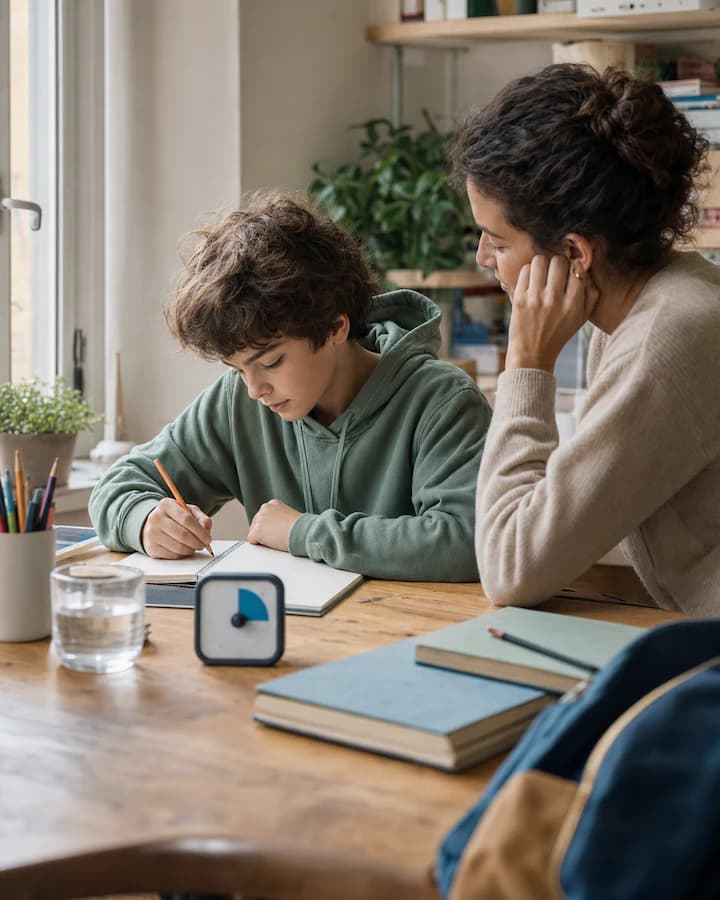
Inattention in children
Attention is not a fixed resource: it varies with the task, context, and available support.
What can inattention look like in children?
Inattention may become apparent when a child loses track of an explanation, forgets a step, is drawn away by their surroundings, struggles to start a task, or needs many reminders to finish. These situations are common at certain points in childhood.
What matters is their frequency, the settings in which they occur, and their consequences. Clinical recommendations do not rely on one isolated observation: they consider development, several areas of life, and actual impact.
Why does inattention vary across settings?
Considering several perspectives avoids interpreting forgetfulness or concentration difficulties too quickly. The same situation can differ greatly depending on organization, noise, interest in the task, or support received.
At home
Transitions, routines, meals, or homework may require many reminders. A parent also notices when the child does better and what kinds of help suit them.
At school
Following instructions, copying, listening, organizing materials, or progressing in a group activity draws on several forms of attention. School provides complementary examples.
In the child's experience
The child may describe feeling lost, having to make a great effort, being bored or tired, or not understanding what is expected.
Being inattentive does not mean never being able to concentrate
Attention is not an on/off switch. It includes selecting information, staying engaged, returning to a task after distraction, and keeping an instruction in mind. A child may therefore be absorbed for a long time in a chosen game and lose track of a multistep exercise. This difference demonstrates neither a lack of willpower nor ADHD: it indicates which demands weigh most heavily on the child.
An instruction such as “pack your bag” actually contains a sequence of actions: stop the current activity, remember the materials, check the schedule, ignore distractions, and finish. Observing where the sequence breaks down allows more precise support than a general reminder to concentrate.
Four kinds of difficulty to distinguish
Select
The child does not identify relevant information amid noise, objects, or several instructions.
Maintain
The child starts correctly but engagement drops before the end of a long or repetitive task.
Resume
After an interruption, the child does not spontaneously find the step where they stopped.
Keep in mind
The instruction is understood at the time but is no longer available when it is time to act.
Adjustments that inform as well as help
Reducing an instruction to one or two steps, moving obvious distractors away, making remaining work visible, or planning a short break can make the task more accessible. The aim is not to eliminate every distraction or monitor the child constantly, but to see which support actually improves independence.
If inattention is new, highly variable, or associated with unusual fatigue, also consider sleep, a learning difficulty, anxiety, a sensory issue, or a life event. Differential diagnosis is the professional's responsibility; parents can support the discussion with dated examples in context.
What kinds of support can help you observe everyday life?
These adjustments do not diagnose ADHD and do not suit every situation. They may, however, help you observe what supports the child at home and at school.
Clarify the task
Breaking a task into simple steps, rephrasing an instruction, or providing a visual cue can reduce the amount to remember and make the situation more accessible.
Adjust the setting
Noise, interruptions, fatigue, or a highly stimulating environment can make sustained attention harder for many children.
Support without blame
Recognizing effort and progress rather than multiplying criticism helps preserve the relationship and understand the child's needs.
Why avoid reducing inattention to a single factor?
Sleep, language or learning difficulties, anxiety, illness, family or school changes, and understanding instructions can influence attention. These are not explanations to choose alone, but possibilities to include in a broader consideration.
A professional assessment aims to distinguish attention difficulties from other possible factors and identify any associated needs.

Preparing for the conversation
Concrete feedback about situations helps prepare for a discussion.
When should you seek professional advice?
It is useful to seek advice if inattention persists, occurs across several settings, and affects learning, relationships, family life, or the child's well-being. A few dated, factual examples are often more helpful than a presumed diagnosis.
The physician or pediatrician can gather this information, consider the child's history, and refer if needed. A screening questionnaire can prepare for this conversation, but cannot replace it.
Cereya ADHD
Describe your child's inattention more clearly without reducing it to a lack of effort
This assessment combines parent responses, the child's perspective, and brief age-appropriate exercises.
It provides informative insights to prepare a discussion, never a medical conclusion.
- assessment supported by a parent or legal guardian
- questions for the parent and child
- brief attention exercises adapted to age
- informative report with points requiring caution
- no medical diagnosis
Initial summary included; detailed analysis available afterward.
Inattention in children
Attention is not a fixed resource: it varies with the task, context, and available support.
FAQ
Frequently asked questions
Can my child concentrate for a long time on something they enjoy?+
Yes. Attention varies with interest, fatigue, understanding of the task, noise, and available support. Being able to concentrate on an enjoyable activity is not enough to draw conclusions about difficulties elsewhere.
Is inattention present all the time?+
Not always. Difficulties may be more visible in long, repetitive, unstructured, or multistep tasks. They may also vary between home and school.
When does inattention deserve further exploration?+
Forgetfulness or fluctuating concentration is common. It is useful to seek advice when these situations persist, recur across several settings, and affect learning, relationships, or family life.
Can other difficulties look like inattention?+
Sleep, anxiety, comprehension difficulties, learning disorders, a period of change, or a highly stimulating environment can also influence attention. A professional considers these as part of a comprehensive assessment.
Can an online questionnaire explain my child's inattention?+
No. A questionnaire can structure observations and prepare a discussion. It cannot replace developmental history, a clinical examination, and information gathered from the child and those around them.
References and resources
This guide draws on recommendations for children and adolescents. They are presented for educational purposes without reproducing diagnostic criteria.
- Haute Autorité de Santé (2024) — Neurodevelopmental disorder/ADHD: diagnosis and therapeutic interventions for children and adolescents
- Haute Autorité de Santé (2015) — Primary care management of a child or adolescent with suspected ADHD
- NICE guideline NG87 — Attention deficit hyperactivity disorder: diagnosis and management
- American Academy of Pediatrics (2019) — Clinical Practice Guideline for the Diagnosis, Evaluation, and Treatment of ADHD in Children and Adolescents
- Faraone et al. (2021) — The World Federation of ADHD International Consensus Statement: 208 Evidence-based conclusions about the disorder
- American Psychiatric Association — DSM-5-TR, referenced descriptively without reproducing diagnostic criteria.
- World Health Organization — ICD-11, referenced descriptively as an international classification framework.
Explore further