Insights for parents
ADHD signs at different ages
Parents often look for a list of signs to find out whether their child might have ADHD. Such lists can help put a concern into words, but they never answer the question on their own.
Inattention, restlessness, and impulsivity change with age, living circumstances, and school demands. What matters is how difficulties recur, where they happen, and what they change for the child.
This guide offers insights by developmental stage without turning common childhood behaviors into a diagnosis.
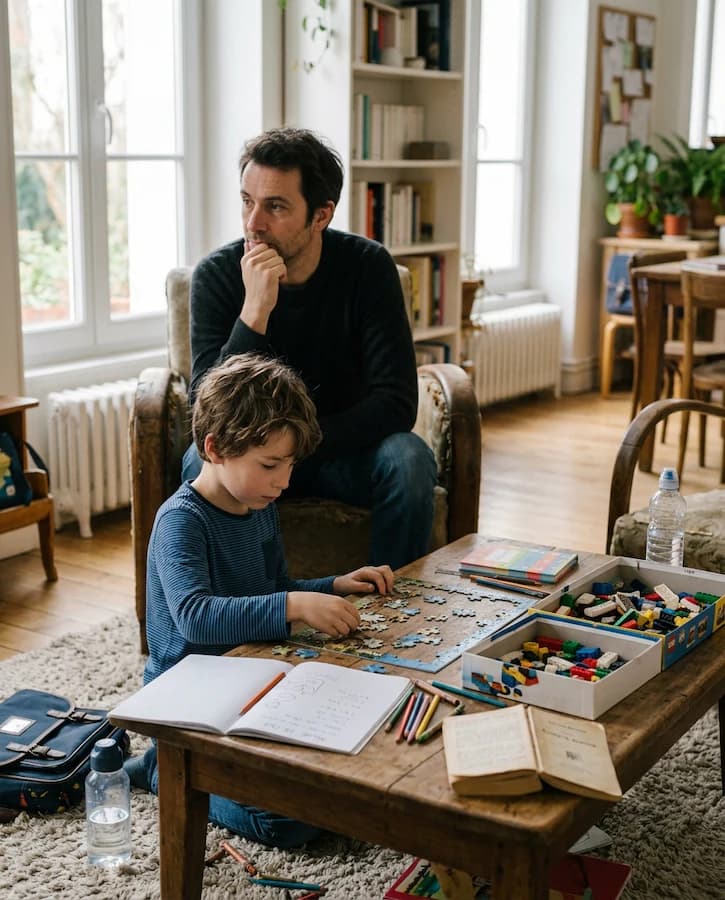
Signs of ADHD in children
Concrete examples across several parts of life are more useful than a label applied too quickly.
What is worth observing at any age
Recommendations describe ADHD through difficulties with inattention, with or without hyperactivity and impulsivity. In a child, these manifestations must be assessed against their developmental level rather than a quick comparison with another child.
A behavior becomes more important to explore when it persists, appears across several settings, and affects school, social, or family life. A difficult day, a period of fatigue, or a misunderstood instruction is not enough to draw a conclusion.
ADHD signs at different ages
Expectations change throughout development: the same ability to wait, organize, or sustain attention is not expected at every age. This is why insights must always be placed in context.
Early childhood
Moving a lot, switching quickly between games, or acting without waiting is common. Attention focuses on whether these difficulties persist, their intensity, and the disruption they cause in daily life.
School age
Multistep instructions, homework, independence, and group life can make inattention, restlessness, or impulsivity more visible. The child may need repeated reminders despite their efforts.
Adolescence
Organizing work, schedules, relationships, and independence become more prominent. The teenager's own experience helps explain the effort they put in, fatigue, or difficulties they feel.
A sign becomes informative when it forms a lasting pattern
Many children forget an instruction, interrupt, or fidget during a meal. To understand what deserves further exploration, look at the whole picture: how long these situations have recurred, where, with what consequences, and in relation to what is usually expected at that age. A dramatic but rare behavior sometimes tells us less than a subtle difficulty that complicates learning or relationships every day.
Context matters too. A child may cope in class thanks to tight structure and then become disorganized at home, or succeed at a fascinating activity while struggling to start an ordinary task. This variability does not cancel out the difficulty. Instead, it helps identify conditions that reduce or amplify it.
What changes with development
Manifestations do not stay the same with age. Looking only for the image of a small child running around can miss a more internalized or organizational difficulty in an older child.
Early childhood
For a young child, behavior is mainly compared with that of children the same age, taking into account the rapid development of self-regulation.
School age
In elementary school, successive instructions, independent work, and group rules sometimes make difficulties more visible.
Adolescence
In adolescence, restlessness may be less visible while organization, time, sleep, and independence become central.
Why can signs vary between home and school?
School may notice certain difficulties earlier because it brings together particular demands: sitting time, instructions, noise, independence, and a group pace. Its feedback is valuable when factual and shared with parents, without asking the school to assign a label.
At home
Parents see routines, transitions, meals, play, homework, and what helps their child regulate themselves.
At school
School observes group work, classroom attention, independence, and interactions with other children.
From the child's perspective
The child can describe their effort to concentrate, what they find difficult, and when they feel more comfortable.
When should you seek professional advice?
It may help to seek advice if difficulties persist, occur across several settings, or affect learning, relationships, family life, or self-esteem. An early conversation does not commit you to a conclusion; it helps clarify the situation.
The child's doctor or pediatrician can gather concerns, consider school feedback, and refer if needed. Clinical assessment also looks for other factors or associated difficulties.

Preparing for the conversation
A few specific examples help more than a conclusion already formed.
What role can a questionnaire or online test play?
A screening questionnaire helps organize observations, compare situations, and prepare questions. It can support a discussion, but its result cannot confirm or rule out ADHD.
A clinical assessment draws on the child's history, development, lived experience, the professional's examination, and information from those around them. This approach avoids reducing a complex situation to a score or list of signs.
A possible approach
01
Observe
notice a few recurring situations and what helps the child
02
Share
gather the child's experience and, where possible, factual feedback from school
03
Seek advice
talk with the professional who cares for the child if the impact persists
Cereya ADHD
Observe several settings before looking for an explanation
This assessment combines a parent's perspective, the child's perspective, and brief age-appropriate exercises.
It offers informative insights to help prepare questions without confirming or ruling out ADHD.
- assessment supported by a parent or legal guardian
- questions for the parent and child
- brief attention exercises adapted to age
- informative report with points requiring caution
- no medical diagnosis
Initial summary included; detailed analysis available afterward.
Signs of ADHD in children
Concrete examples across several parts of life are more useful than a label applied too quickly.
FAQ
Frequently asked questions
Are ADHD signs the same at every age?+
No. Behaviors change with development and the expectations of those around the child. A professional interprets them in light of age, the child's history, several settings, and their concrete impact.
Can a child have attention difficulties without being very restless?+
Not necessarily. Some children mainly have difficulties with attention and organization, with little visible restlessness. This cannot be interpreted from a single setting or behavior.
Why does school sometimes notice difficulties first?+
School requires following instructions, organizing work, and functioning in a group. It may therefore notice difficulties that are less visible at home. This feedback complements the family's observations; it is not a diagnosis.
When should you seek professional advice?+
Advice is useful if difficulties persist, occur in several settings, or affect learning, relationships, family life, or the child's well-being. You do not need to be certain before talking to the child's doctor.
Can a screening questionnaire make a diagnosis?+
No. A questionnaire can help describe situations and prepare a discussion. It does not replace a clinical interview, an examination of the child, or information gathered from those around them.
References and resources
This guide draws on recommendations for children and adolescents. They are presented for educational purposes without reproducing diagnostic criteria.
- Haute Autorité de Santé (2024) — Neurodevelopmental disorder/ADHD: diagnosis and therapeutic interventions for children and adolescents
- Haute Autorité de Santé (2015) — Primary care management of a child or adolescent with suspected ADHD
- NICE guideline NG87 — Attention deficit hyperactivity disorder: diagnosis and management
- American Academy of Pediatrics (2019) — Clinical Practice Guideline for the Diagnosis, Evaluation, and Treatment of ADHD in Children and Adolescents
- Faraone et al. (2021) — The World Federation of ADHD International Consensus Statement: 208 Evidence-based conclusions about the disorder
- American Psychiatric Association — DSM-5-TR, referenced descriptively without reproducing diagnostic criteria.
- World Health Organization — ICD-11, referenced descriptively as an international classification framework.
Explore further